 Upload BOM
 Cart (
 Inside Memristor Technology: Materials, Fabrication, and Applications
Author:admin Date: 2025-12-22 10:25 Views:159
Introduction
A memristor is a two-terminal passive electrical component that regulates the flow of electric current in the circuit and remembers the amount of charge that has gone through it previously. This unique ability to retain its resistance state even without power makes it a non-volatile memory device.
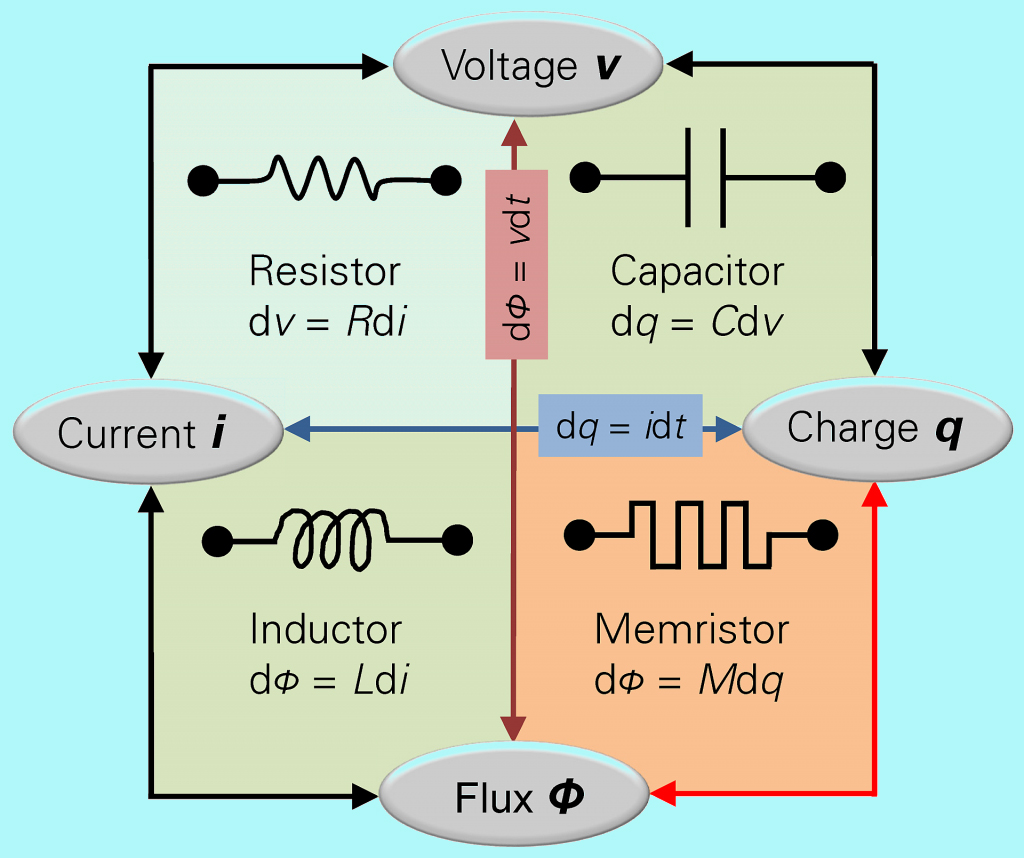
How does a Memristor work?
The working principle of a memristor is simple, it simply changes its internal resistance depending on the history of current passing through it.
Here is the mechanism of operation of a memristor
- Ion movement: The active material is divided into two regions: one heavily doped with mobile charged ions (a good conductor), and the other less doped (an insulator).
- Resistance modulation: This is when the voltage is applied, and the mobile ions drift.
When a voltage with one polarity is applied, the ions move, expanding the conductive region. This lowers the device’s overall resistance, making it more conductive.
When a voltage of opposite polarity is applied, the ions move back, shrinking the conductive region. As expected, there will be a higher resistance in the memristor. - Non-volatile memory: When power is removed, the ions stop moving and remain in their last positions. This makes the device store its resistance state. The next time you apply power, the memristor resumes operation with that specific resistance value.
Electrical Characteristics of a Memristor
The primary electrical characteristics of a memristor help you understand more about how they work and how they can be used. The key electrical properties include:
Non-linearity
Unlike the traditional linear resistor, the current-voltage relationship of a memristor is non-linear. The resistance is a function of the total charge which has flowed through the device over time. It is not just the instantaneous voltage and current.
Non-volatility
Whenever power is removed, the memristor maintains the most recent resistance value indefinitely. This means it does not require to have a continuous power supply for it to remember its state. This is a key feature for non-volatile memory applications.
Pinched Hysteresis Loop
Whenever subjected to periodic voltage or current, the memristor’s I-V curve forms a characteristic pinched, figure-eight-shaped loop. The loop crosses the origin (zero voltage and zero current).
The shape and area of the loop depend on the direction, duration, and amplitude of the applied signal.
As the frequency of the input signal increases, the loop area shrinks. At high frequencies, the loop degenerates into a straight line, behaving like a conventional linear resistor.
Passivity
An ideal memristor is a passive device; this means it does not generate or store energy. This is unlike a capacitor or inductor. It dissipates energy as heat, like a resistor.
Multi-level Conductance
The resistance can be set to multiple intermediate states between the minimum and maximum values. This allows for analog information storage or multi-bit memory. This is an essential property in neuromorphic computing, where it can mimic the variable strength of the biological synapses.
Types of Memristors
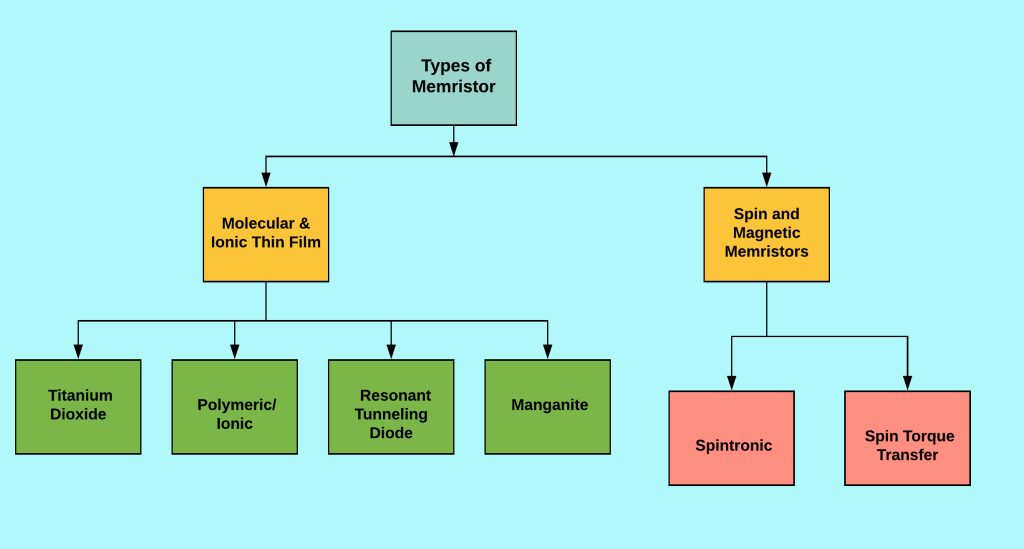
Memristors are largely categorized based on the material used in their active switching layer and the physical mechanism, which causes resistance to change. The main types of memristors you can expect include:
- Metal-Oxide Memristors
This is the most common type in the memristor market. It was epitomized by HP Labs, which used a thin film of titanium dioxide. The resistive switching is based on the formation and disruption of the conductive filament in the active layer. This is achieved by migrating oxygen vacancies. The other materials that can be used in these memristors include hafnium oxide, nickel oxide, and zirconium oxide.
- Phase-change Memristors
These devices use materials that can be switched between a high-resistance amorphous state and a low-resistance crystalline state using the heat generated by the electrical current. This is the basis of using phase-change memory (PCM) technology.
- Ferroelectric Memristors
Such memristors use a ferroelectric material as the insulating layer. An external electric field can switch the polarization of this layer. This alters the interface barrier and also the device’s resistance.
- Spin-Based/Magnetic Memristors
These are based on spintronics principles, where the resistance changes depending on the electron spin property. It also depends on the relative magnetization of electrodes in a magnetic tunnel junction (MTJ).
The resistance state is non-volatile and can be controlled through a spin-transfer torque mechanism.
- Organic and Biomolecular Memristors
This is another memristor type where researchers are exploring the use of organic polymers, such as graphene, as active switching layers. These are low-cost and flexible, which makes them great candidates for bio-compatible electronics.
- 2D Memristors (Atomristors)
Such memristors use atomically thin two-dimensional materials such as molybdenum disulfide or graphene oxide as the active layers. Such materials offer excellent scalability depending on your application and unique electrical properties for next-generation devices.
Applications of Memristors
Memristors have a wide range of current and potential future applications. This is mainly due to their non-volatile memory, high density, low power consumption, and the ability to store and process data at the same time.
Here are the key applications of memristors:
Neuromorphic computing and AI
Memristors are a foundational component in neuromorphic computing. This aims to mimic the function and structure of a human brain. You can take their gradual, analog resistance change, which is similar to the strengthening and weakening of the biological synapses. This feature makes them ideal as artificial synapses for building neural networks.
They also offer high-energy efficiency and fast machine learning capabilities. This is especially for edge computing or on-device applications such as image recognition in autonomous vehicles.
Non-Volatile Memory
Memristors offer a promising alternative to traditional flash memory and DRAM. The Resistive Random Access Memory (ReRAM) offer many advantages, such as offering a higher data density, low power consumption, and faster read/write speeds. This technology may lead to instant-on computers and more efficient solid-state drives.
In-Memory Computing and Logic Circuits
Memristors allow for computation to occur within the memory unit. Such helps in overcoming performance bottlenecks. The compute-in-memory architecture means you end up with high-speed performance for processing the complex arithmetic operations and logic functions.
Hardware Security
Memristors can be used to create unique hardware fingerprints due to their inherent variability and randomness of their switching mechanisms. These can then be used for secure authentication, key generation, and random number generation. Such results in better cybersecurity and protect data in IoT and mobile devices.
Reconfigurable Electronics
In this sense, memristors can dynamically change and retain their resistance state, which makes them suitable for reconfigurable radio-frequency (RF) circuits and filters. This can adapt their performance on the fly depending on the communication standards and application.
Advantages and Limitations of Memristor Technology
Memristor as a technology comes with multiple pros and cons. Here is what you can expect.
Advantages
- Memristors offer non-volatile memory
- They come with high density and scalability options
- They consume less power but still work great
- The memristors offer fast operation speeds
- They have neuromorphic computing capabilities
- They are compatible with CMOS systems
- Memristors can perform analog computations directly in the memory
Disadvantages
- Expect variations in performance as memristors have an inherent randomness in the formation of the conductive filaments.
- Memristors are not yet widely commercially available as standalone components
- Since it is also a relatively new circuit element, expect to face challenges in designing the circuits.
Memristors vs Conventional Memory Technologies
Memristors are promising to be the best non-volatile memory on the market that offers significant advantages over what we use currently. Below is a table outlining the main differences between memristors and conventional memory technologies.
| Feature | Memristors | Conventional Memory |
| Volatility | Non-volatile | DRAM is volatileFlash is non-volatile |
| Storage mechanism | Stores data as a change in resistance | Stores data as an electrical charge |
| Power consumption | Low power operationZero standby leakage power because of non-volatility | Higher power consumption in DRAM due to constant refreshing |
| Speed | Fast read/write speeds | DRAM has high-speed access speedsFlash memory may have slower writing speeds |
| Architecture | Simple two-terminal crossbar structure. This enables high-density integration and in-memory computing. | It is transistor-based with separate memory and processing units. This leads to a bottleneck in data transfer. |
| Neuromorphic potential | Can mimic biological synapses, which makes them ideal for neuromorphic computing | Not inherently suited for neuromorphic computing without the complex peripheral circuits |
Testing, Reliability & Performance Evaluation of Memristors
Evaluating the reliability and performance of memristors is key to their transition to commercial applications. Some of the key metrics include retention, endurance, and variability. These are assessed through specialized testing protocols.
The key performance and reliability metrics include:
- Endurance, which determines the number of read/write cycles a device can withstand before permanent failure.
- Retention is the duration over which a stored resistance state or data is maintained without power. Devices are typically tested to ensure data retention of at least ten years.
- Variability is the consistency of the device’s characteristics both from cycle-to-cycle within a single device and from device-to-device (D2D) across an array or bath.
- Switching speed and energy are the time and power required, respectively, to change the resistance state. This is crucial for performance and energy efficiency.
- On/Off ratio is the ratio between the high resistance state and the low resistance state. This should be high enough to distinguish between logic states reliably.
Conclusion
Memristors are among the exciting breakthroughs in modern electronics. They are faster, non-volatile, and consume less power. These are all important features we want compared to conventional flash memory. Since they also emulate neural behavior, they have found applications in neuromorphic computing. Yes, it might have a few downsides, but their reliability and performance make them better.
Please send RFQ , we will respond immediately.
Frequently Asked Questions
Are memristors the same as ReRAM?
ReRAM or resistive RAM is a type of memory that uses memristor technology. All ReRAM devices use memristors, but not all memristors are ReRAMs. We find that ReRAMs are commercially available memory products that use resistive-switching principles.
What are the materials used in building memristors?
Multiple materials are used in building memristors. These include titanium dioxide, hafnium oxide, tantalum oxide, silicon oxide, organic polymers, and phase-change materials. Each material can affect the switching speed, endurance, and energy efficiency.
What is a memristor crossbar array?
A crossbar array is a grid of horizontal and vertical wires with memoristors at each intersection. The work of these arrays is to allow for high-speed parallel computation. They are essential for in-memory computing and an analog AI accelerator.