 Upload BOM
 Cart (
 Resistance Wire: What It Is and How It Works
Author:admin Date: 2025-12-05 09:10 Views:108
Introduction
A resistance wire is an alloy wire that is engineered to oppose the flow of electric current and then converts the electrical energy into heat. Having this property makes a resistance wire quite vital in a wide range of heating elements and resistors for both industrial and domestic applications.
Key Electrical Properties of Resistance Wires
Various electrical properties of the resistance wire determine how effectively it can perform in its application. Here are the most important properties you should know.
High Resistivity
This is an important property. The resistance wires are made from alloys with high resistivity. This resistivity is many times higher than that of standard conductors such as silver or copper. This means that even for a short length of resistance wire, it will have significant resistance.
Concentrating the opposition of current flow and generating a usable amount of heat because of the collision of electrons with metal atoms, makes it quite versatile in heating applications.
Temperature Coefficient of Resistance (TCR)
The TCR describes how much a material’s resistance changes with temperature. For heating elements such as toasters and furnaces, a low or stable TCR is preferred so that the resistance value does not fluctuate dramatically when the resistance wire heats up. This allows for a predictable and stable heat output.
Precision resistors or sensing elements use specific alloys as they have extremely low TCR. Such ensures the resistance remains almost constant despite the ambient temperature variations.
Oxidation and Corrosion Resistance
This might not be a direct electrical property, but it is still important for a material to withstand the high temperatures in air without rapidly oxidizing or corroding.
For instance, when nichrome heats up, it forms a protective thermodynamically stable layer of chromium oxide. This prevents further degradation, ensuring a long and reliable operating life.
High Melting Point
Resistance wires must have a high melting point to operate safely and effectively at red-hot temperatures without melting or becoming brittle. For example, Nichrome has a high melting point of 1400 degrees Celsius, while Kanthal can work effectively up to 1425 degrees Celsius.
How Resistance Wire Works
Resistance wire works based on the principle of Joule heating. This is where the wire’s high electrical resistance impedes the flow of electrons, which causes a conversion of electrical energy into thermal energy because of the microscopic collisions.
At the fundamental level, the process can be explained as:
- When a voltage is applied to the wire, free electrons are accelerated and move through the material’s crystal lattice.
- As the electrons move, they will collide with the fixed positive metal ions in the alloy structure
- Each collision transfers kinetic energy from the moving electrons to the metal ions
- The added energy makes the ions vibrate more vigorously, increasing the material’s internal kinetic energy. This manifests as a rise in temperature. The heat is dissipated into the surrounding environment.
Essential Factors for Effective Heating
Unlike highly conductive materials such as copper, which are designed to allow current to flow with minimal energy loss, resistance wire is built for high-efficiency heat generation. This is based on a number of factors:
- High resistivity: Alloys such as Kanthal and Nichrome have an intrinsically high resistivity, meaning they offer much greater opposition to current flow than standard conductors. This force leads to more collisions at a given current, thereby maximizing heat production.
- Joule’s Law: The amount of heat generated can be quantified by using Joule’s Law of Heating. It states that the heat produced is directly proportional to the square of the current, time, and resistance.
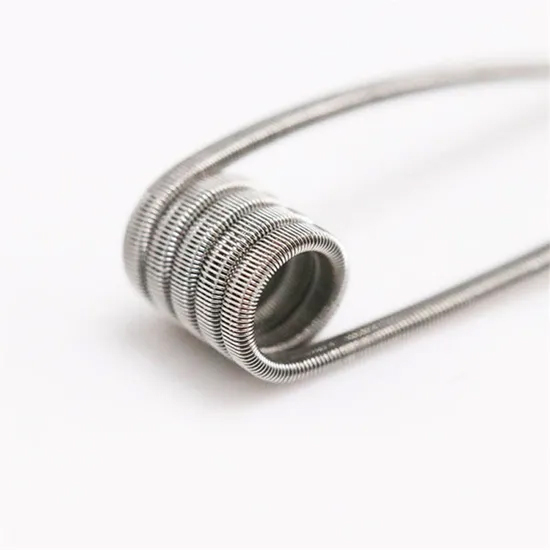
- Physical Design: The resistance wire is coiled to maximize its length within a small area, further increasing total resistance and concentrating the heating effect in a compact space. You can expect such a design in toaster elements or electric heaters.
Common Materials Used in Resistance Wires
The most common materials used in resistance wires are specific metal alloys that can deliver the best performance as resistance wires. Here are some of the top options in the market.
Nichrome (Nickel-Chromium Alloys)
This one comes with 80% nickel and 20% chromium, though some can come with iron added as well.
They possess high resistivity, excellent oxidation resistance, and can retain mechanical strength at high temperatures. This activity forms a protective oxide layer when heated, which further prevents degradation.
These are widely used for heating elements in household appliances such as hair dryers, electric heaters, and toasters.
Kanthal (Iron-Chromum-Aluminum Alloys)
It contains primarily iron, chromium, and aluminium. The standard alloys, such as Kanthal A-1, contain approximately 73% iron, 22% chromium, and 5% aluminium.
Such alloys are known for their high-temperature operation and excellent oxidation resistance. It has high resistivity and excellent form stability.
You will come across such alloys in demanding high-temperature industrial applications. This includes kilns, heat treatment, and glass manufacturing.
Constantan/Cupronickel (Copper-Nickel Alloys)
Generally comes with 55% copper and 45% nickel.
It is characterized by having medium resistivity and a very low temperature coefficient of resistance. This means the resistance remains stable over a wide temperature range. It is also easily soldered compared to Nichrome or Kanthal.
As for applications, they are used in precision resistors, potentiometers, and straight gauges. You will also find them as one leg in thermocouples, where the stable resistance across varying temperatures is vital.
Manganin (Copper-Manganese-Nickel Alloys)
It is made of 86% copper, 12% manganese, and 2% nickel.
Just like Constantan, it is also good for an extremely low temperature coefficient of resistance. This makes it suitable for highly stable electrical components.
It is used for making standard resistors and precision wire-wound resistors, where accuracy is highly paramount.
Applications of Resistance Wires
Resistance wire materials are widely used across many sectors. They are primarily used in household appliances, industrial systems, and specialized applications. Here are the main applications of resistance wires.
Household Applications
The resistance wire is a fundamental component in many household items that require heating.
It is used in electric overalls, toaster ovens, kettles, and electric stove burners to generate the heat needed to cook and boil water.
It is also found in hair dryers, electric blankets, and curling irons, providing controlled heat depending on the application.
You can also find the resistance wire in electric heaters, baseboard heaters, and heated flooring systems for climate control and commercial buildings.
Industrial Applications
You will find resistance wire in industrial settings as well. This is because they can also handle high-temperature processes and precise control systems.
Industrial furnaces and kilns use Kanthal alloys as heating elements for firing ceramics, melting glass, and heat-treating metals. This is because the alloys can withstand the extremely high temperatures and resist oxidation.
The same can also be used in wire cutting, especially for applications such as cutting through foam, plastics, and rubber in manufacturing and artistic applications.
The resistance wire can also be integrated into molds and dies to maintain the precise temperature needed for plastic injection molding and extrusion processes.
Medical devices such as incubators, sterilizers, and heated surgical tools use the resistance wire to ensure consistent and controlled heating, which is necessary for safety and performance.
Specialized and Electronic Applications
Resistance wires are also used in applications beyond simple heating because they offer stable and predictable electrical properties.
Constantan and platinum wires are used in temperature measurement devices such as resistance temperature detectors and thermocouples, where changes in resistance correlate precisely with temperature changes.
Wire-wound resistors, made from alloys like Constantan or Manganin, are used in electrical circuits to limit current flow or in rheostats for adjustable voltage control.
Aerospace and automotive industries also use resistance wire in their de-icing systems or in heated seats and rear window defrosters.
Selection and Sizing of Resistance Wire
Selecting and sizing of resistance wire can be simple if you know what to do. First, you will need to calculate the resistance needed for a desired power output and then determine the appropriate material, diameter, and length to achieve that resistance. Do not forget to keep in mind the environmental factors as well.
Here are the key steps for selection and sizing resistance wire.
- Using the Ohm’s Law and power formulas, get the right resistance needed for your application.
- Choose the appropriate alloy. The chosen material should be based on the required operating temperature, environment, and the desired performance characteristics. For example, Nichrome is best for domestic and industrial heating while Kanthal works best for even higher temperatures, so it works best for industrial furnaces.
- Calculate the required wire dimensions. This can be found by using the materials specific resistivity and the required resistance to determine the length and diameter of the wire.
- Do not forget the environmental and physical factors as well. This includes the temperature coefficient or resistance, physical constraints which mean you may have to tightly wind the wire into a coil, the current carrying capacity, and voltage drop.
Testing and Measuring Resistance Wire
The DC resistance and temperature coefficient of resistance (TCR) are the main things you can test and measure in resistance wire.
Measuring DC Resistance
A digital multimeter can be used in this case, but sometimes specialized equipment and techniques are needed for very low resistance such as those below 10 Ω.
- Two-Wire Method
This is a good method you can use with standard multimeters. It is suitable for resistance values above 10 Ω, meaning the lead and contact resistance errors are negligible.
- Censure the power to the circuit is OFF
- Set the multimeter dial to resistance function
- Insert the leads into their respective jacks
- Touch the probes to the ends of the resistance wire
- Read the resistance value on the multimeter display
- Four-Wire Method
This method is suitable for measuring very low resistance with high accuracy. It is used for eliminating errors from the test leads and contact resistance since you use separate pairs of leads for sourcing current and measuring voltage.
- Use a micro-ohmeter or a high precision multimeter that supports four-wire measure capability.
- Two outer leads source a known, constant current through the resistance wire
- Two inner leads measure the voltage drop directly across the specific section of the wire being measured
- The instrument calculates the precise resistance
The advantage of this method is that it ensures the voltage drop across the current-carrying leads and contact points are not included in the voltage measurement. This makes it provide a more accurate reading of the actual resistance of the wire.
Measuring the Temperature Coefficient of Resistance
The TCR is determined by measuring the resistance at different but known temperatures. You will need an ohmmeter, a stable temperature source, thermometer, and resistance wire.
- Measure the resistance of the sample resistance wire at a known reference temperature
- Submerge the wire into the stable temperature environment. It can be boiling water or ice water.
- Allow the temperature to stabilize and then measure the new resistance at that specific temperature.
- Calculate the TCR with all these values now.
How Resistance Wire Can Degrade: Improving Lifespan
Resistance wire can degrade primarily due to oxidation at high temperatures, mechanical stress, and thermal cycling. This leads to a reduced wire’s cross section and eventually failure. Improving the lifespan involves choosing the right material for the application, controlled operation, and proper installation.
Oxidation and Corrosion
At high temperatures, the metal oxides in presence of air. Oxidation lead to the formation of a protective oxide layer, but the process consumes the metal slowly. Such a gradual reduction in the wire’s cross-sectional area increases the resistance over time and can eventually lead to breaking.
Thermal Cycling
The repeated heating and cooling cycles cause the metal to expand and contract. This constant physical stress can lead to embrittlement, micro-cracking, and eventually mechanical failure.
Contamination
Impurities in the operating environment can be damaging. We are talking of traces of sulfur, dust, chlorine, oil, and others interfere with the formation of the protective oxide layer. This leads to an aggressive localized corrosion and premature failure.
Overheating and Overloading
Operating the resistance wire beyond its maximum rated temperature or current capacity accelerates oxidation and may cause rapid melting and fusing of the wire.
Improper Installation/Mechanical Stress
Bending the wire too sharply or having insufficient slack to allow for expansion can cause physical damage. It is the same when it is operated in an environment with excess vibration.
How to Improve Resistance Wire Lifespan
- Select the correct material for the application
- Always operate within the stated ratings
- Minimize on thermal cycling to lessen thermal fatigue
- Follow the manufacturer guidelines on proper installation
- Maintain a clean environment free from contaminants
- Regular inspection and maintenance are necessary to check for damage, loose connections, and signs of damage.
Conclusion
Resistance wire is an important engineering material defined by its high electrical resistivity and ability to efficiently convert the electrical energy into heat. This is done through the Joule heating process. The main key allows for resistance wire including Nichrome and Kanthal. They are picked specifically for their stability at high temperature and overall performance in many applications. Always take care of the resistance wire and it should last a long time.
Please send RFQ , we will respond immediately.
Frequently Asked Questions
Why is Nichrome a popular choice for heating applications?
Nichrome can easily withstand very high temperatures, it does not oxidize quickly, and maintains a stable resistance even when hot. Such features make it more reliable, durable, and also safe for heating elements.
How do you choose the right resistance wire gauge?
Choose the gauge of wire depending on the desired resistance per meter, the power or wattage requirements, space constraints of the project, voltage, and temperature of the application.
Can resistance wire be soldered?
Generally no. Resistance wire materials such as Nichrome and Kantal do not work well with regular solder. Instead, you can connect them using crimp connectors, high-temperature connectors, screw terminals, and spot welding.