 Upload BOM
 Cart (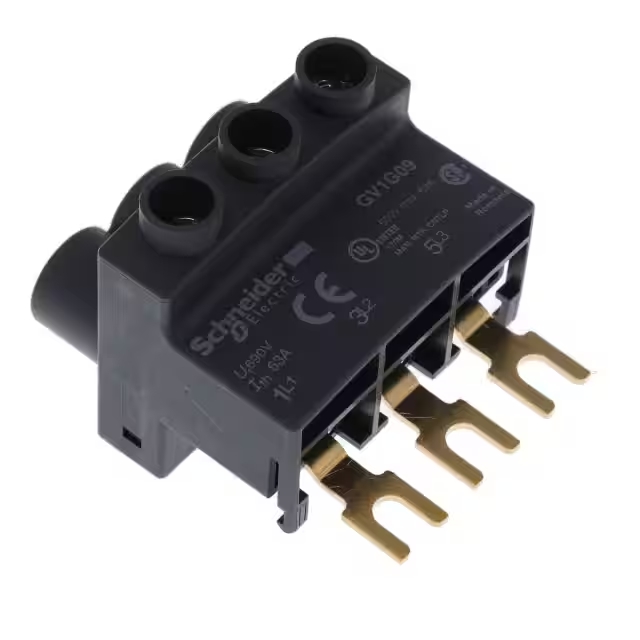
GV1G09 datasheet & 3D
- AccessoryType: Active
- Package: 1


FREE delivery for orders over HK$250.00

Quick response, quick quotaton

Flash shipment,no worries after sales

Original channel,guarantee of the authentic products
GV1G09
The GV1G09 is part of Schneider’s TeSys series, designed specifically for use with GV2 circuit breakers. If you’re setting up quick and straightforward power distribution, this terminal is ideal. It connects easily through the GV2G busbar at the top, making wiring hassle-free, especially for three-phase systems. It handles currents up to 63A and voltages as high as 690V, with an insulation rating of 690V and IP20 protection—perfect for typical industrial environments. It supports wire sizes from 1.5 to 25 mm², making it widely used in industrial equipment and distribution cabinets.
GV1G09 Pinout Diagram

| Terminal | Description |
|---|---|
| L1 | Phase 1 (Input/Output) |
| L2 | Phase 2 (Input/Output) |
| L3 | Phase 3 (Input/Output) |
The GV1G09 is a busbar connector from Schneider’s TeSys series, designed specifically for their circuit breakers. It’s got three poles labeled L1, L2, and L3, perfect if you’re working with three-phase power. When wiring it up, double-check the phase order, or you’ll run into phase sequence problems. Wire sizes from 1.5 to 25 mm² are fine—choose the right thickness to keep your connections sturdy. And remember, always double-check that the power’s off during installation or maintenance to stay safe.
GV1G09 Equivalent Display Controller

| Parameter | GV1G09 | GV2G09 | GV3G66 | 3RV1925-5AB | BB-3P-60A |
|---|---|---|---|---|---|
| Manufacturer | Schneider Electric | Schneider Electric | Schneider Electric | Siemens | ABB |
| Poles | 3 | 3 | 3 | 3 | 3 |
| Rated Current | 63 A | 63 A | 63 A | 63 A | 60 A |
| Rated Voltage | 690 VAC | 690 VAC | 690 VAC | 690 VAC | 690 VAC |
| Wire Cross-section | 1.5–25 mm² | 1.5–25 mm² | 2.5–35 mm² | 1.5–25 mm² | 1.5–25 mm² |
When you’re picking a connector similar to GV1G09, check carefully if it fits your circuit breaker. Make sure the rated current and the wire size match exactly what you need, so installation stays smooth and trouble-free.
GV1G09 Microcontroller Wiring Circuit

Here’s the setup in plain terms: you feed 220 VAC through L1, L2 and hook up protective earth (PE). Your Arduino Nano drives a relay that switches those live lines over to the GV1G09 inputs. A sensor or switch marked “G” tells the Nano when to pull in the relay. Once it closes, L1 and L2 energize the GV1G09 module, which then sends power through its normally-open contacts to the motor. When those contacts snap shut, the motor spins up. It’s a neat trick to let your Nano’s low-voltage signal handle high-voltage AC without breaking a sweat.
GV1G09 IC Footprint and Package
Think of the GV1G09 as a small block roughly 4 cm tall, 5 cm wide and 5.5 cm deep, weighing about 48 g. It has three screw terminals for L1, L2 and L3, fitting solid wires from AWG 4 or 1.5–16 mm² and stripped flex wires of 1.5–6 mm². Inside, forked copper clips snap onto busbars or PCB posts spaced ~16–18 mm apart. For PCB layout, add matching 3–4 mm mounting holes, keep ≥2.5 mm clearance around conductors, and use glue or mechanical braces after reflow. Mount it on a TeSys D/U rail.
GV1G09 Signal Interface Example
Let me break down how you connect this setup. Your three-phase power (usually 220 or 380V AC) goes into terminals labeled L1, L2, and L3. On the other side, wires go out from the bus to your motor—marked as U, V, and W. Your Arduino Nano, using something simple like digital pin D3, controls an isolated relay module. This relay basically switches the high-voltage power on or off. So, when your Nano sends a signal, the relay clicks on, letting the power flow through GV1G09 into your motor, starting it up. When the Nano cuts the signal, the relay opens up, the power stops, and the motor shuts off—easy as that.
GV1G09 SMD IC Application Tutorial
Let’s clarify first—GV1G09 isn’t your typical SMD chip; it’s actually a busbar terminal block from Schneider Electric for industrial three-phase setups. Here’s how you hook it up simply: Take your 220V or 380V three-phase input (L1, L2, L3) into a relay or contactor module, controlled by your Arduino Nano (pin D3 works fine). When your Arduino outputs a signal, it triggers the relay, sending power through GV1G09 to your three-phase motor or heater. Quick Arduino code can cycle your motor on and off. Keep it simple, insulated, and safe with relay isolation between the Arduino and the high voltage.
More Like This

RS309-MD-EV900A
Sinofuse
RS309-MD-EV700A
Sinofuse
RS309-MD-EV800A
Sinofuse
RS309-MD-EVS125A-D
Sinofuse
RS309-MD-EVD150A
Sinofuse
RS309-MD-EVS80A-D
Sinofuse
RS309-MD-EVD175A
Sinofuse
RS309-MD-EVS200
Sinofuse
RS309-MD-EVS100A-D
Sinofuse
RS309-MD-EVS150A-D
Sinofuse
RS309-MD-EVD100A
Sinofuse
RS309-MD-EVS250A
Sinofuse
Also Add to Cart
C308F160MA-TR1
Eaton - Electronics Division
2421-31-N
Bourns Inc.

MOVGT20V250K
Eaton - Electronics Division
01520900Z
Littelfuse Inc.

JLLN350.XXP
Littelfuse Inc.
0683G2500-01
Bel Fuse Inc.
200E2CL15.5
Littelfuse Inc.
03621.25V
Littelfuse Inc.
FLSR04.5T
Littelfuse Inc.

0034.6810
SCHURTER Inc.
LFR604003C
Littelfuse Inc.

CVQ130K10BL1
Bourns Inc.
Related Products
RS309-MD-EV900A
Sinofuse
RS309-MD-EV700A
Sinofuse
RS309-MD-EV800A
Sinofuse
RS309-MD-EVS125A-D
Sinofuse
RS309-MD-EVD150A
Sinofuse
RS309-MD-EVS80A-D
Sinofuse
RS309-MD-EVD175A
Sinofuse
RS309-MD-EVS200
Sinofuse
RS309-MD-EVS100A-D
Sinofuse
RS309-MD-EVS150A-D
Sinofuse
RS309-MD-EVD100A
Sinofuse
RS309-MD-EVS250A
Sinofuse
SP-250ANLKIT2
Spartan Power
SP-200ANLKIT2
Spartan Power

CIP136400010
Victron Energy
CIP136100010
Victron Energy
SP-250ANLKIT
Spartan Power
CIP136300010
Victron Energy
CIP136125010
Victron Energy
SP-400ANLKIT2
Spartan Power
SP-ANL300FUSE
Spartan Power
CIP136060010
Victron Energy
SP-ANL400FUSE
Spartan Power
SP-ANL200FUSE
Spartan Power
SP-ANL80FUSE
Spartan Power
SP-ANL35FUSE
Spartan Power
SP-150ANLKIT
Spartan Power
SP-ANL50FUSE
Spartan Power
SP-ANL250FUSE
Spartan Power
CIP136500010
Victron Energy
Please send RFQ , we will respond immediately.
