 Upload BOM
 Cart (
SN74AVC2T245RSWR datasheet | TI details
- Translator Type: Voltage Level
- Channel Type: Bidirectional
- Output Type: Tri-State, Non-Inverted
- Package: 10-UFQFN


FREE delivery for orders over HK$250.00

Quick response, quick quotaton

Flash shipment,no worries after sales

Original channel,guarantee of the authentic products
SN74AVC2T245RSWR
When designing circuits, you’ll often need a convenient way to bridge signals between different voltage systems. The SN74AVC2T245RSWR is a neat solution—it’s a dual-channel, bidirectional level shifter that smoothly converts voltages from 1.2V to 3.6V, like going between 1.8V and 3.3V systems. With ultra-low delay (less than 2ns), it’s ideal for high-speed buses. It’s easy to use too, featuring DIR and OE pins for direction and output control, making bus sharing straightforward. Its tiny UQFN-10 package, super-low power, and 15kV ESD protection make it perfect for compact, energy-efficient designs.
SN74AVC2T245RSWR Pinout Diagram
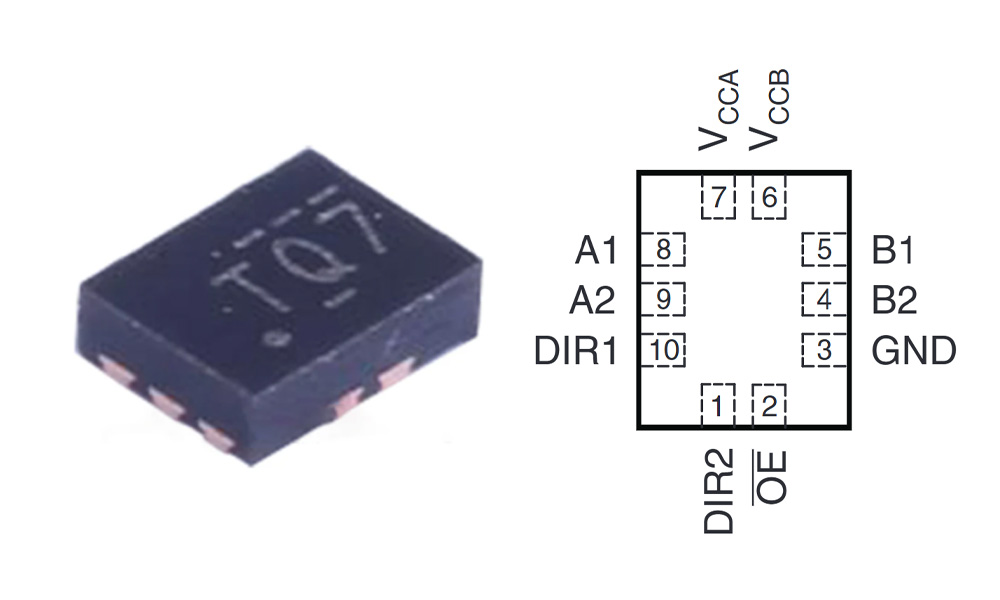
| Pin Number | Pin Name | Type | Description |
|---|---|---|---|
| 1 | DIR | Input | Direction control: Low = B → A, High = A → B |
| 2 | A1 | I/O (VCCA) | Channel 1 A side, controlled by DIR |
| 3 | A2 | I/O (VCCA) | Channel 2 A side |
| 4 | OE | Input | Output Enable (active low). OE = 0: enabled, OE = 1: high impedance |
| 5 | GND | Power | Ground |
| 6 | B2 | I/O (VCCB) | Channel 2 B side |
| 7 | B1 | I/O (VCCB) | Channel 1 B side |
| 8 | VCCB | Power | B side power input, supports 1.2V–3.6V |
| 9 | VCCA | Power | A side power input, supports 1.2V–3.6V |
| 10 | NC | – | Reserved / Not connected |
When you’re using the SN74AVC2T245RSWR chip, remember that VCCA and VCCB can run at different voltages, like converting between 1.8V and 3.3V systems. Keep in mind, it doesn’t auto-detect signal direction—you’ll need to set this using the DIR pin. Also, make sure the OE pin is pulled low to activate data transfer; otherwise, your outputs stay in high impedance (Hi-Z). Each side’s I/O pins follow their respective voltage rails, so don’t mix them up. A good tip: placing a small 0.1uF capacitor near the chip helps maintain stable power and improves performance at high speeds.
SN74AVC2T245RSWR Equivalent Level Shifter
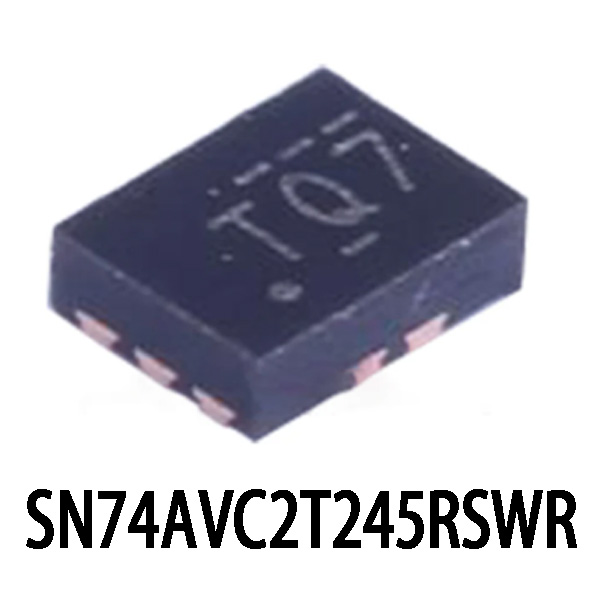
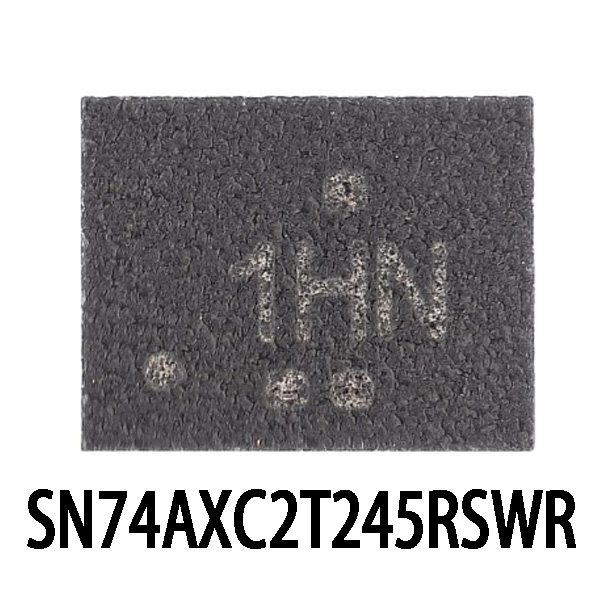
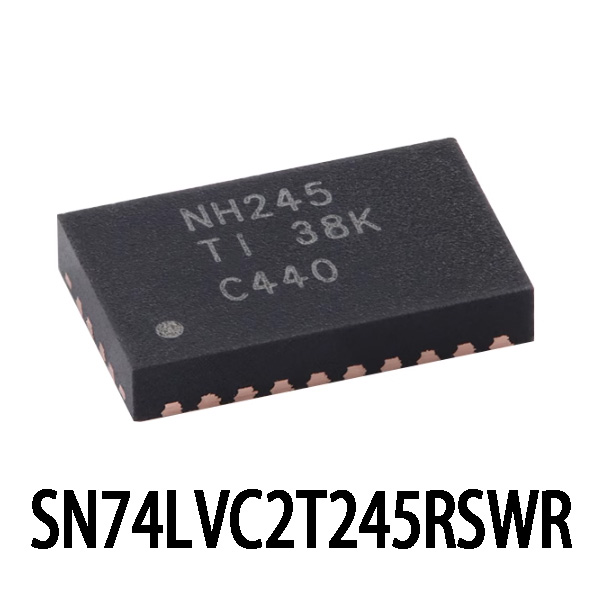
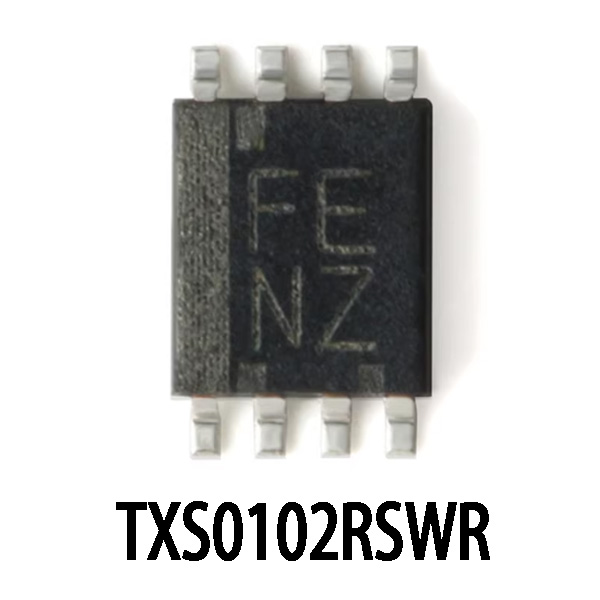
| Parameter | SN74AVC2T245RSWR | SN74AXC2T245RSWR | SN74LVC2T245RSWR | TXS0102RSWR |
|---|---|---|---|---|
| Channel Count | 2 Bidirectional | 2 Bidirectional | 2 Bidirectional | 2 Auto Direction |
| Package | UQFN-10 (RSW) | UQFN-10 (RSW) | UQFN-10 (RSW) | UQFN-10 (RSW) |
| Voltage Range VCCA | 1.2V – 3.6V | 0.65V – 3.6V | 1.65V – 5.5V | 1.2V – 3.6V |
| Voltage Range VCCB | 1.2V – 3.6V | 1.2V – 3.6V | 1.65V – 5.5V | 1.65V – 5.5V |
| Max Data Rate (typ) | 380 Mbps | >1 Gbps | 380 Mbps | ~24 Mbps |
| Direction Control | DIR Pin Control | DIR Pin Control | DIR Pin Control | Auto Direction Sensing |
| Output Enable (OE) | Yes | Yes | Yes | Yes |
| Hot-Plug Support | Yes | Yes | Yes | Yes |
| Typical Voltage Application | 1.8V ↔ 3.3V | 1.2V ↔ 3.3V | 3.3V ↔ 5V | 1.8V ↔ 5V |
When choosing replacements for SN74AVC2T245RSWR, here’s my quick advice: If you need higher speed and lower voltage support (down to 0.65V), SN74AXC2T245RSWR is your best upgrade, fully compatible and great for high-speed interfaces. If you’re working with classic 5V systems (like 5V to 3.3V signals), SN74LVC2T245RSWR fits well, but its lower voltage limit is 1.65V—not ideal for 1.2V systems. Lastly, TXS0102RSWR offers automatic direction detection, perfect for I²C or UART to simplify control, but unsuitable if your bus needs strict direction management.
SN74AVC2T245RSWR Voltage Translator Circuit
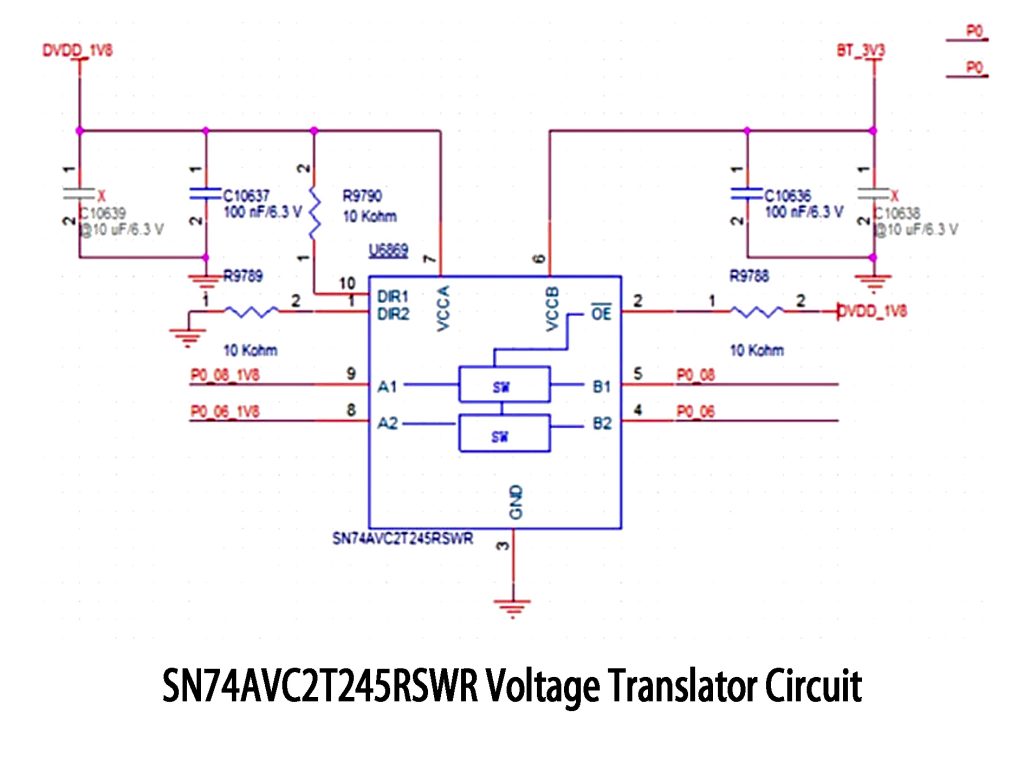
Here’s a quick rundown on using the SN74AVC2T245RSWR: It’s designed to shift two signals between 1.8V (A side) and 3.3V (B side), ideal for bridging SoC and peripherals. By default, DIR is pulled low to 1.8V via a 10k resistor, meaning signals go from 3.3V down to 1.8V. To flip direction, just pull DIR high (1.8V). Connect OE directly to 3.3V, or use GPIO if you need dynamic control. Place decoupling capacitors close by for stable operation. Be careful not to swap VCCA and VCCB. Also, it’s tiny, so handle PCB layout carefully.
SN74AVC2T245RSWR Bidirectional Level Converter
When designing circuits, you’ll often need to bridge signals between different voltage levels. The SN74AVC2T245RSWR is a handy chip for this. It lets you manually set the data direction with the DIR pin: set DIR high to shift signals from the lower-voltage A side to higher-voltage B side, and low for the opposite. Unlike automatic level shifters, this one offers precise timing, ideal for high-speed connections between an FPGA or MCU and peripherals. Don’t forget to place a 0.1μF capacitor near each power supply pin for stable operation.
SN74AVC2T245RSWR I2C SPI Voltage Shifting
If you’re using SPI for level shifting, the SN74AVC2T245RSWR chip is perfect. Set DIR high for master-out lines (MOSI, SCK, CS) and low for master-in lines (MISO). But don’t use it for I²C—the chip isn’t designed for that. I²C requires automatic direction detection and open-drain compatibility, whereas SN74AVC2T245 uses push-pull outputs, potentially damaging the bus. Instead, pick specialized chips like TXS0102 or PCA9306 for reliable I²C shifting.
SN74AVC2T245RSWR SMD Logic Level Wiring
When you’re wiring up the SN74AVC2T245RSWR on your PCB, keep it straightforward: connect VCCA to your lower voltage (like 1.8V), VCCB to the higher voltage (like 3.3V), and place a 0.1μF capacitor close to each supply pin. Set DIR high for A-to-B conversion, low for B-to-A. Keep OE low to enable outputs. Keep PCB traces short and neat to avoid interference. Also, since the UQFN-10 package is tiny, handle soldering carefully.
More Like This

MC5430F
Motorola

JD54LS51BCA
National Semiconductor

USPLSI2032VE-110LB49
Lattice Semiconductor Corporation
74S22PC
Rochester Electronics, LLC

9504DC
National Semiconductor

9005PC
National Semiconductor
9007DC
National Semiconductor
9004DC
National Semiconductor

SN74HC804DWR
Texas Instruments
SN700863DWR
Texas Instruments
4001BDMQB
National Semiconductor
54F02FMQB
National Semiconductor
Also Add to Cart

TLE9867QXA20XUMA1
Infineon Technologies
MAX6424UK26
Analog Devices Inc./Maxim Integrated
.JPG "LM4950TSX/NOPB")
LM4950TSX/NOPB
Texas Instruments

DS1501YZN+T&R
Analog Devices Inc./Maxim Integrated

SN74LVC245APWRG4
Texas Instruments
TLV320DAC3101IRHBT
Texas Instruments

MCP2155-I/SS
Microchip Technology

AFE5401TRGCRQ1
Texas Instruments
TC7W14FK,LF
Toshiba Semiconductor and Storage
72235LB15TFGI8
Renesas Electronics America Inc

8N4SV76BC-0162CDI8
Renesas Electronics America Inc
S6BP401AB1SN1B20A
Cypress Semiconductor Corp
Related Products
MC5430F
Motorola
JD54LS51BCA
National Semiconductor
USPLSI2032VE-110LB49
Lattice Semiconductor Corporation
74S22PC
Rochester Electronics, LLC
9504DC
National Semiconductor
9005PC
National Semiconductor
9007DC
National Semiconductor
9004DC
National Semiconductor
SN74HC804DWR
Texas Instruments
SN700863DWR
Texas Instruments
4001BDMQB
National Semiconductor
54F02FMQB
National Semiconductor
DM54S20W/883
National Semiconductor

MC3129L
Motorola
4071BDM
National Semiconductor
MC9814P
Motorola
MC9825P
Motorola

74AC11000NS
Texas Instruments
MC5420L
Motorola
MC5401L
Motorola
MC5401F
Motorola
SN74H61N
Texas Instruments
MC5410F
Motorola
MC5430L
Motorola
SN74AS138N-J
Texas Instruments
CD4023BCN
Fairchild Semiconductor
4019BDC
National Semiconductor
74H40DC
National Semiconductor
5420FMQB
National Semiconductor
4025BDM
National Semiconductor
Please send RFQ , we will respond immediately.
